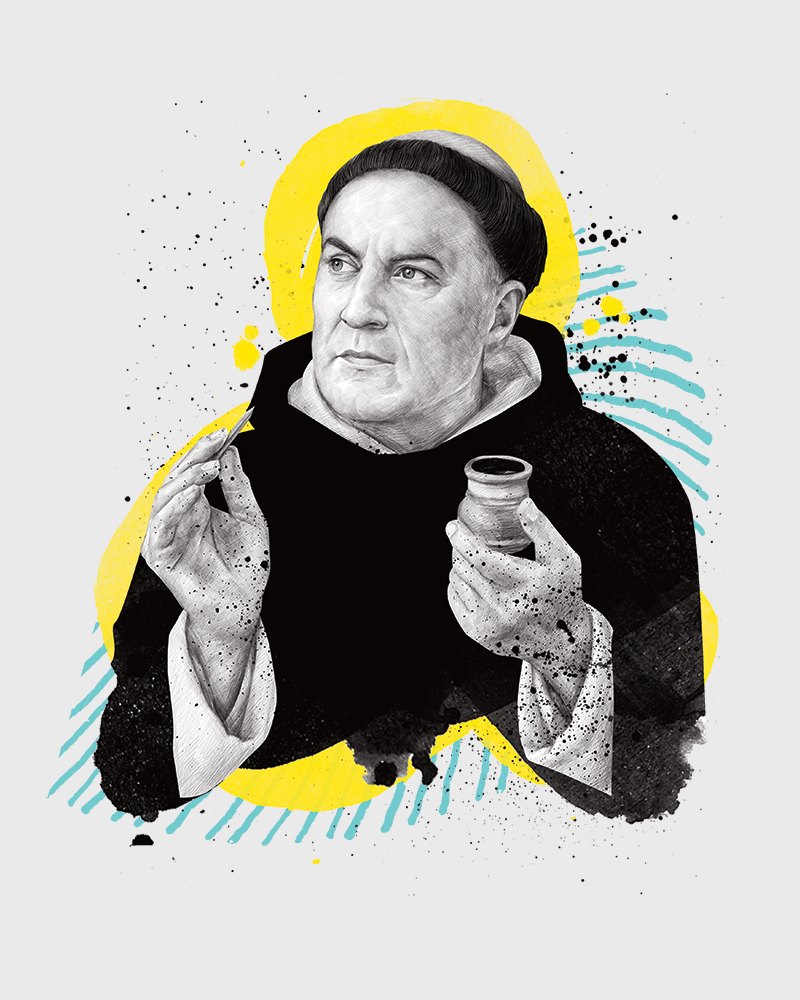
Thomas Aquinas is considered one of the greatest Christian thinkers of all time. His ideas have shaped Christian belief, education, and philosophy for more than 750 years. Even today, students, pastors, and scholars continue to study his writings. One of his most important arguments was that faith and reason work together. Instead of seeing science, logic, and faith as enemies, Thomas believed they help us discover truth.
Thomas was born around 1225 in Sicily and grew up in a wealthy family. His parents expected him to become the abbot of the famous Monte Cassino monastery, a position that would have brought great honor and influence on their family. But Thomas chose a very different path. He joined the Order of Preachers, also known as the Dominicans, a group dedicated to preaching, teaching, and serving others.
His family was furious. They restricted his movements, locking him up for nearly a year, hoping he would change his mind. Despite the pressure, Thomas refused to give up his calling. His courage and determination showed he was willing to follow God’s plan, even when it meant disappointing the people closest to him.
Thomas spent his life studying the Bible and philosophy. He was especially influenced by the Greek philosopher Aristotle. Instead of rejecting philosophy, Thomas believed that the ability to think and reason was a gift from God. He argued that careful study of the natural world could reveal truths about God and creation. At the same time, he believed that some truths — such as God’s plan of salvation — can only be understood through Scripture. This balance between faith and reason became one of his greatest contributions to Christianity.
His most famous book, “Summa Theologica,” was written to help students preparing for Christian ministry. Rather than simply giving answers, Thomas organized the book by asking important questions, presenting different opinions, and then carefully explaining his conclusions. He discussed topics such as the existence of God, right and wrong, human nature, justice, virtues, and the life of Christ. His method teaches an important lesson: Real learning happens when we are willing to ask honest questions, listen to different viewpoints, and think carefully before reaching a conclusion.
Thomas died in 1274 at the age of 49. In 1323, he was declared a saint by the Church. Later, he received the title Doctor of the Church, one of the highest honors given to Christian teachers whose writings have had a lasting impact.
The life of Thomas still speaks to young people today. He encourages everyone to ask difficult questions, think carefully, and never be afraid to learn. In a world where faith and science are sometimes presented as opposites, he reminds us that reason and faith can work together to help us better understand God, ourselves, and the world He created.
So What?
What questions about God are you wrestling with right now, and how are you exploring various sources, perspectives and opinions as you form your own understanding of faith?
Illustration by Paul Ryding.
You May Also Like