Q&A with Kirby Kelly
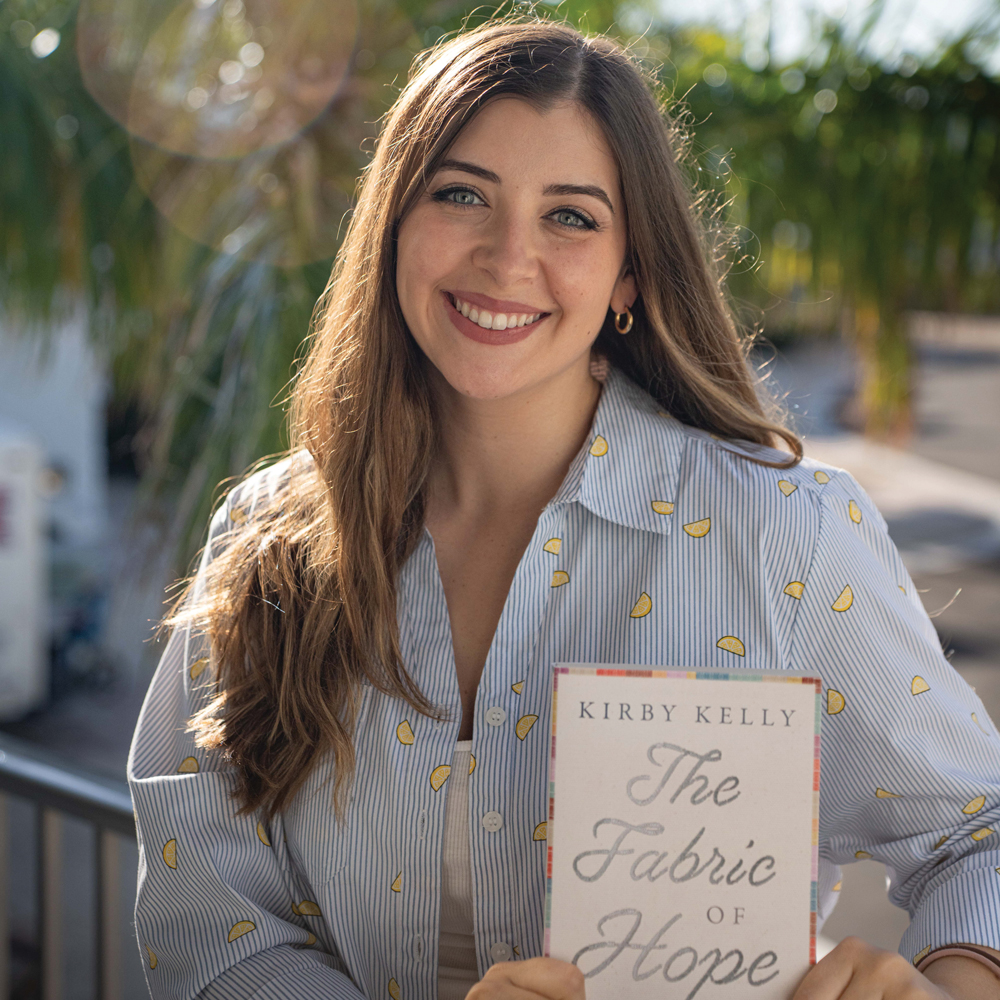
“But biblical hope is different because it is confident expectation that is rooted in God's character, promises, and faithfulness. We can have hope in the season that we are in. Not just wishful thinking for what's to come, but confident hope in our God who is with us in this place today.”Kirby Kelly is a speaker, author, podcast host, and content creator based in Dallas, TX who has spent over a decade using digital platforms to equip, empower, and engage a global audience with the Gospel. Her most recent book, “The Fabric of Hope,” helps readers discover how God weaves redemption into every season.
PEER: What was the writing process like? Take us briefly through your writing routine — from the initial creation, through the messy drafts, and into the final version that the readers would hold in their hands.
KIRBY KELLY: With this being my second book, I went into it with the expectation that it would be similar to my first book. With my first book, I felt like the Lord just gave me an absolute download of showing me the method, the steps, and the building blocks in which you’re going to write this book. But when I started drafting up and dreaming about what book number two would look like, it ended up being completely different. Where I felt like it began with me really just taking time to analyze my own story rather than having this building block method. But getting into the nitty gritty parts of, well, where was God in these moments of my life and starting there? It was really mapping out where I saw Him working in the tension of these places marked by grief and lament, but also where there were these high moments of hope, resilience and where God came through and redeemed.
After mapping that out, I began to see overarching themes. The more and more I pressed into my own stories and seeing stories in scripture that lined up with experiences I had with God firsthand, it began to naturally blend together; rather than being these building blocks that build on step 1, 2, 3, and 4, it really was more focusing on specific themes.
In one chapter I have stories where we talk about hope and about God stepping in and redeeming. In these stories, I see a lot of themes of suffering and asking the hard questions and grouping those things together. In the rest of this book, I see stories of peace and anxiety and how God was able to come in and redeem and restore that area. Or this area where I was struggling with trust and doubt but ended up coming out the other side having a deeper trust in who God was. I think stepping back and starting with looking at my own story and then seeing how that relates to the biblical story, and the key themes that I know relate to the reader story, that’s how it began to just unfold and become what it was now.
It’s very thematic in each chapter. It was very different than writing the first book, but with this book, it was a lot more introspective of things that I was walking through and processing. Which made the process that much more intimate in my relationship with God. That much more relational of even unpacking things as I was writing and not just going off reference from past seasons.
P: I love hearing about writing routines. I think whatever you’re writing, it bleeds from your heart. That leads me into my next question. What inspired you to write “The Fabric of Hope,” your second book?
KK: Absolutely. When I was dreaming up and drafting up ideas for book number two, hope was the thing that stuck out to me most. Not only did I see that as a huge need within my online audience, in the readers who bought my first book, but I saw it for people in the world. The last five or six years has been a lot for a lot of people. People’s entire lives have been a lot.
I know for my own life when I started writing this book, I was currently going through a season where I desperately needed hope. Back in 2023, when I began dreaming about this book and really 2024 when I started writing the book, I was going through a season of loss. My mom had died — suddenly, and traumatically, as it happened out of nowhere. As I was celebrating the launch of my first book, graduating with my master’s in theology, and all of these big moments that called for celebration and praise even to God for what He had done in those areas, I was still holding onto so much grief, so much lament. A lot of just included asking God hard questions. I realized that in being transparent online about what I was going through, and the feedback I was getting from that, that was a felt need.
People were wrestling with this tension and living in this in-between of there are really great things happening and I see God here so why am I not seeing Him here in these really hard parts where I am desperately crying out to Him?
I’m trying to reconcile both of these places that I’m coexisting in — lament and celebration. But that’s where I was in that season. As I was processing it, navigating it online, and started thinking back on my whole life, and in those moments where I questioned God in other seasons of suffering or loss or disappointment, one thing that was continuously true in my whole story, even if it took time, was that God was actively redeeming everything. I knew that if He could actively and had redeemed things in the past, then He could redeem this situation right now. He could bring hope to this situation right now. As I was living it, I realized this is something I actually confidently believe that God is a redeemer. I have hope in that. There are many people who don’t have that confident conviction. I want to walk alongside the readers who pick up this book and help them to see that God can really weave redemption into their story. That’s why I use the analogy of fabric. It is this beautiful thing that is woven together. I know that if we were to like step back and look at the tapestry of our own lives, on one side it might not make sense.
We see all the loose threads. Maybe you see where there were seasons of life circumstances. People who came in and tore parts of your fabric — people who came in and completely shredded and destroyed areas of your life. But God comes in, and I use this analogy in the book with his silver lining thread, and He’s able to weave in redemption back together and patch over the areas that we thought were unredeemable. I use that as an analogy to show people that as much as He is our comforter and like a blanket, we can wrap ourselves with God. Like He shows up and He’s present and He comforts us in these places. Similar to a banner in the Old Testament, these things that would fly high and reign true and proclaim confident faith in God. We can also say: Look at what He did. Look at who my God is in this place. I think that is just a really strong analogy for what God can do in our individual lives that we thought can’t be patched together.
P: You mentioned losing your mom. You also wrote about being a child of parents who struggled with addiction. How did those early experiences shape your view of God and hope?
KK: I think a lot of us, especially in our childhoods, can attribute our reflections of authority onto who God is. A lot of the times that is our parents. It could be our caregivers, it could be pastors, it could be teachers. I don’t know. For me, when it came to my parents, I lived in such an unstable environment. Where there was chaos, where there were things completely out of my control because of their drinking, because of their alcoholism and their addiction issues, that caused me as a child to just feel totally unsafe. There was this need to have answers, to assume control, and to make sure that everything was pretty and fine and put together. Because number one, I didn’t want to risk people seeing how unfine, how broken my life really was. But I also needed and craved that sense of security. When we look at the original creation narrative that we were designed to live in, it was a world that wasn’t broken. We were designed to live and abide with God in His order under His plans and protection in peace.
But because of humanity’s rebellion and sinful nature, here we are where there is chaos, where there is disorder. That was my life for a long time. When it came to me trusting God, there were certain areas where I felt comfortable trusting Him, but there were other areas where I didn’t know if I could trust Him. I think some of that was because of my parents’ own example, but a lot of that was also me having this need, this desire to have any sort of answer or control in my own grasp. But how many of us know that we are not ultimately in control of our own situations sometimes, definitely the decisions of other people, and the brokenness of this world. It’s not like we can go in as individuals, solve every issue, and make it work out perfectly. But the One who is able to step in and redeem those things is God. Even balancing the idea of His sovereignty and man’s free will, God can still step in and do something great as we learn to yield to Him, as we learn to individually trust in Him, and submit to His control and plan. That was something that I really had to learn and unpack and unravel in my own life. Was that my God? He’s a perfect and present father who loves me and wants to work out all things for good.
Sometimes that doesn’t look like how I expected. Sometimes that doesn’t work out on my own timeline, but what is true is that when I look back on my own life and as I listen to the stories of other people who have been faithful to God and reading through scripture, I can see that those who have yielded their will to bend and to be malleable to God’s will in way, it always worked out for greater good. It always worked out for greater glory. Even if it didn’t line up with what we initially would have deemed or called good. God’s definition of good is so much better than our definition of good. That’s something that I’ve been able to see in my own life that even in the areas that weren’t good, my parents’ addiction being one of them, I wouldn’t necessarily say that that is a good thing, but I’ve been able to see how God used something that was so bad for something so good when I trusted in Him and I allowed him to step in to do healing on my heart. And to even use me as a witness to my mom specifically. Because I got saved when I was 14.
My dad died when I was 10. I got to see redemption in the relationship with my mom in that area too. God can work out all these things for good, but we also need to, I think, really unpack areas of trauma, disappointment, and see if we’re using that against God rather than inviting Him in to do something with it.
P: How can someone cultivate hope during a season of uncertainty, doubt, waiting or grief?
KK: I’ve been there. In uncertain seasons, hope isn’t just about having clarity, it’s about having Christ. I think that anyone can cultivate hope in their life. It begins by being honest with God about the doubts, about the disappointments, about the very real questions that keep us up at night. It also looks like staying grounded in scripture. Really looking at the promises of God, the personhood of God, the presence of God, the patterns of God.
I go into all four of those things very deep in my book because that is what we put our hope in. We put our hope in Christ, but specifically in His presence, His promises, His patterns, and His personhood.
Another way we cultivate hope is by remembering that waiting doesn’t mean that God is absent. Or just because something doesn’t work out in the way that we expect doesn’t mean that God isn’t in that place or isn’t moving behind the scenes. Often it means that He’s working beneath the surface. He’s doing things that we do not yet perceive.
For the person who needs hope today, don’t put it in the outcome. Don’t put it in the circumstance. Don’t put it in other people. Don’t put it in yourself. Find out who God really is through scripture and put your hope in that — His character. Because when we put our hope in circumstance versus God’s character, that’s when we end up in further doubt, further disappointment, and further disarray. But when we put it in Christ, we end up walking out of these places and actually living in these places with hope, with joy, and with peace that surpasses understanding.
P: Oftentimes it’s hard to trust God when life feels out of control. You write about God’s will and trusting God’s will even when it doesn’t align with our plans. How can one, especially at this age, trust Him when life feels out of their control?
KK: My mom relapsed right after I gave my life to Jesus when I was 14. Not only was I navigating the highs and lows of high school and stepping into kind of this season where I’m discovering who I am, who God has called me to be, asking all these important questions, I was also going through the thick of: What is going on here, God? I completely relate to the young person who’s listening today who feels like everything is just out of control in more ways than one, and asking that question of, can I really trust you, God? But again, I’ll reiterate, we can trust God.
I really want to home in on this based on His patterns and His promises. When we look at patterns in scripture, He is faithful in everything that He does. He’s faithful to continuously pursue His people even if they have rebelled. He is faithful to step in and bring about restoration where there was once desolation. He can do that when we invite Him in. He meets His people, His weeping prophets, those who feel forgotten and like they’re on the outskirts and the outside of society, He meets them in the middle of their mess where there is brokenness, where it feels like there are pieces shattered and scattered beyond repair, and He brings peace and resolution to those places.
He takes those and makes it a mosaic of something that’s even more beautiful. But the key thing is, is that we have to take that active step of saying, being honest with God about hurt.
My mom ended up dying because of her addiction in 2023, so I didn’t necessarily see the resolution I had hoped for. But I still have my hope in God and trusting God because He still did exceedingly and abundantly more in that place. She ended up giving her life to Jesus. She ended up receiving a lot of healing in many ways, and so did I. I grew in so many ways, not only in my relationship with God, but in reconciliation with my mother in empathy for other people, in being able to minister to people from a place of, I actually relate to you like I am right now. I see a lot of value in that. I think we can trust that God does bring about resolution and adds value to the things that we would’ve once discredited. You can have hope today in His pattern of faithfully showing up every time, redeeming when we show up. And we even just give Him a mustard-seed-size faith opportunity. Can you just move in this small way? Can you just show up? Can you comfort me? Will you just be my father in this place? He will because that’s a promise of who He is as well. We can look at His promises and His patterns and of hope in that alone. Even when there is uncertainty in the circumstance that we’re in today of how that might unfold.
P: You blend lament and celebration together. You don’t often hear those words together, but can you share about how those two go hand in hand?
KK: Lament and celebration belong together because I think they both tell a very important truth. It’s the truth that life is hard and God is faithful. Both exist. Holding them together keeps us in a place of honesty about our pain, but also hopeful about His promises.
And in the Bible, lament isn’t the opposite of worship. I think that we can equate praise with worship and lament with, well, you just don’t trust God and you’re complaining when that’s not true. It’s part of the worship process because what I’ve noticed in my studies of the lament, whether that be in the book of Lamentations or in the Psalms, is that lament always ends with hope. It always ends with a remembrance of, “But you are my God.” But you show up, but vengeance is the Lord’s. You redeem and you restore. You are just and you are these things. It returns to this place of hope. But it begins with this place of honesty. Honest grievances, honest questions, honest complaints. Celebration doesn’t deny grief either. It declares that grief doesn’t get the final word in this. That that disappointment, sorrow, and suffering don’t have the final word. That God can still step in and continue to write the story and actually close the chapter Himself, not just us closing the book on our life or situation or season. So together, lament and celebration form a faith that can suffer honestly, but also still trust God deeply for what is to come.
P: Overall, how has writing this book deepened your relationship with God and hope? Did you learn anything new about God or hope while writing?
KK: I don’t know if I necessarily learned “something new” about God, but I think that I experienced a freshness in my relationship with God. When I was writing this book, that season of life felt like such a long and dark cold winter for me. Of losing my mom and going through that grief and just all the questions of what if that can come from that place. For a long time, it felt like there was a lot of missing broken pieces in my life. I’m not saying that those have returned because my mom isn’t here. But what God did was that He showed me so much kindness in that time. Like so much comfort in that time. I know those are easy words to throw out, but if you’ve been in that place where you just really need like a comforting word, a hug, presence from someone, anyone who gets it that was Jesus. That was Jesus for me — is for me still today. The kindness that I experienced of God in that season was something that I needed in the middle of my winter. When I finished writing this book and I submitted it, and all was said and done with that, I remember reading scripture. The Lord spoke to me and He said, “I’m bringing you into your spring.”
He said, “I’m bringing you into your spring now.” That was such a beautiful gift from God. That not only did He meet me in my winter, but He also walked with me in that place and has now delivered me into a springtime season where things are blossoming, things are blooming. What was dead, what was iced over, has now watered the earth so that something new can grow here. As much as I felt hope in that season where it was cold and dark, I have even more hope now coming out the other side, having experienced God in that place. I don’t know if that was necessarily something new that I learned, but I’m in a new place and I learned that through walking through hardship and holding onto the hope that God has given me. That’s what I would say to that.
P: Sometimes the hardest lessons that you learn are through the valleys, through the cold winters, you often feel like you’re hibernating and then all of a sudden, it’s green again. Again, it’s blending that lament and celebration. If just anyone who holds your book could take away only one truth from this book, what do you hope it would be?
KK: The definition of what hope really is. biblical hope is not wishful thinking. That is how we often use the word hope — “I hope I get a good grade on this test that I didn’t study for,” or “I hope I get a really good parking spot at the grocery store.” It’s this wishful thinking. We just throw it into the wind and we hope it sticks. But biblical hope is different because it is confident expectation that is rooted in God’s character, promises, and faithfulness. We can have hope in the season that we are in. Not just wishful thinking for what’s to come, but confident hope in our God who is with us in this place today.
For Further Reflection
P: How do you practice self-care when feeling overwhelmed?
KK: Stillness. I feel like that is a spiritual discipline that a lot of us forget. Like, yes, reading the Word is important, worship is important, prayer is important — but I think for me, when I am in seasons of overwhelm or spiraling or it feels like everything is too much, I really need to slow down and get still, reflect, and remember the promises of God and the presence of God in my life. That is what brings me peace and resolution when it feels like everything is just way too complicated and out of my control.
P: What are you currently reading? What are you currently listening to?
KK: A book that I’m actually re-reading a second time: it’s called “Whole: The Life Changing Power of Relating to God with All of Yourself” by Aaron Williams and Kathryn Maack, and it is so good. It’s all about just the different ways that God has uniquely created us and we have certain lean in certain areas of our life, but how do we blend both like spirit and truth, the head and the heart. That’s a phenomenal book that I recommend. As far as listening to, I honestly have been listening to a lot of Christian rap recently, so Hulvey. I think that’s because I’m also about to give birth to a baby at the end of April. I’m just trying to get myself hyped up for this birth. My pregnancy playlist might not sound like a lot of Hillsong. It might sound like a lot of Hulvey just to get myself pumped up to push this baby out.
P: What’s a Bible verse or passage that was on your heart while writing this book?
KK: The cornerstone Bible verse for this book is Romans 15:13, and it says, “May the God of hope fill you with all joy and peace as you trust in him, so that you may overflow with hope by the power of the Holy Spirit” (NIV).
You May Also Like